Feb 27, 2011

Friend Me on Facebook!

To all my readers...

I am expanding my fan base, but I need your help! Please add me on Facebook today! www.facebook.com/eirinn.cunningham

Tell everyone you know about Houseplant Care Guides, especially if they love plants! Become my friend on Facebook to learn more about my interests! Email me any plant questions you have at: espressomocha86@hotmail.com! Need plant advice, but don't see your plant questions answered here?? Tell me about it! Send me a message... I'd love to hear from you!

Brightest Blessings,
Eirinn

Check out http://www.pagancenter.com/

Do you need more blogs to read?
Visit 'Domestic Witch': http://domesticwitch.blogspot.com/
Or try 'Raven's Voodoo Lounge': http://ravenzvoodoolounge.blogspot.com/
Read 'Living The Secret': http://kellyconcord.blogspot.com/

Feb 5, 2011

The Magick Plants of Westland

Here’s a bit about the Magickal plants in Westland – plants growing in our yard that I researched on the net because I’m a plant dork:

We have Bittersweet Nightshade or Climbing Nightshade (Solanum dulcamara) growing up the fence by our driveway. The plant is not related to Belladonna, but has the name ‘climbing’ nightshade (as opposed to ‘Deadly Nightshade’). Its berries ARE poisonous to humans and most animals, except birds. The plant is considered a weed, but I’m going to keep it – it’s not harmful to the touch. It is invasive, but not dangerous, and will not damage other plants. Just do not eat!

Good for protection and fairy magick. Releases painful or bitter memories. Typically needs something to climb up, like a pole, a fence or a trellis.

Solanum dulcamara, also known as bittersweet, bittersweet nightshade, bitter nightshade, blue bindweed, Amara Dulcis, climbing nightshade, fellenwort, felonwood, poisonberry, poisonflower, scarlet berry, snakeberry, trailing bittersweet, trailing nightshade, violet bloom, or woody nightshade, is a species of vine in the potato genus Solanum, family Solanaceae. It is native to Europe and Asia, and widely naturalized elsewhere, including North America, where it is an invasive problem weed. It occurs in a very wide range of habitats, from woodlands to scrubland, hedges and marshes. It is an invasive species in the Great Lakes region and was first spotted in 1843.

Bittersweet is a semi-woody herbaceous perennial vine, which scrambles over other plants, capable of reaching a height of 4 m where suitable support is available, but more often 1–2 meters high. The leaves are 4–12 cm long, roughly arrowhead-shaped, and often lobed at the base. The flowers are in loose clusters of 3–20, 1–1.5 cm across, star-shaped, with five purple petals and yellow stamens and style pointing forward. The fruit is an ovoid red berry about 1 cm long, soft and juicy, but edible for birds, which disperse the seeds widely.

Bittersweet is used in naturopathy and herbalism. Its main usage is for conditions that have an impact on the skin, mucous membrane and the membrane (synovial membrane) around the joints. Bittersweet is considered by some to be a herbal remedy for treating herpes and allergies.

Although fatal human poisonings are rare, several cases have been documented. The poison is believed to be solanine.

The name bittersweet is also used in some areas for some species in the genus Celastrus (elsewhere referred to as the staff vines, family Celastraceae), e.g. American bittersweet (Celastrus scandens) and oriental bittersweet (Celastrus orbiculatus).

Another Magick plant we have growing by the driveway is called Bishop’s Weed (Aegopodium podagraria), the variegated variety. Also known as Goutweed, Ground Elder, and Snow on the Mountain. It was thought by the Ancient Greeks to be a cure for gout: the Latin names, Aegopodium from the Greek translates as "goat little foot", referring to the fact that the plant was once thought to cure gout. And podagraria translates as "foot chain" for its leaf shape and again its supposed ability to treat gout.

Today, Snow on the Mountain is commonly used as a groundcover (although is considered rather unattractive these days), and is highly resistant to weed killers. Most people won’t plant it for fear it will get out of hand, and because of its reputation for being a weed. The variegated variety is used preferably over the green variety, which spreads faster and easier than its cousin. Prefers sunny conditions and moist soil.

See the entry for Bishop’s Weed in The Illustrated Encyclopedia of Magical Plants by Susan Gregg.

The Weed of Death


Currently, I live in Westland, Michigan with my boyfriend of 4 years, Kenny. We are both renting a place right now, and let me tell you – the property has some of its own ‘planty’ surprises! During the growing season, we are faced with the horror that is…unspeakable! I’m so distraught by its fury I can’t even talk about it!

Ok, there. I took a deep breath. It’s a truly nasty surprise noticeable in the late spring and all summer long: False Bindweed, also known as the Morning Glory Vine or Hedge Bindweed. Its scientific name is Calystegia spp.

This demon is an invasive weed that winds around other plant stems clockwise …and kills them. Anything you have growing nearby that it decides to attack will die, if the weed is given free reign and enough time to perform its hideous murder!

…Bushes are fair game. Small tress and mature and trees alike are fair game. Watch out! If you notice Bindweed near any plants you want to keep—take action now—before it’s too late!!

About Morning Glory Vine

This weedy perennial vine will twine all over the garden, covering your ornamental plants to the point of smothering them. It is usually introduced by seed or invasive roots from under the neighbor's fence. Its success as a weed lies in its thick fleshy roots which travel long distances just under the soil surface. Since morning glory is a perennial weed, control lies in removing the root system. Hand weeding can remove large quantities of roots, but any broken pieces are capable of sprouting new growth. Repeated, persistent digging as the new growth sprouts can deplete the food reserves. If chemical control is required, cut back the growth and apply the material to leaves or stems in as localized a fashion as possible.

The Weed From Hell
One man’s fight with The Weed of Death is revealed below. Eventually he was able to win the battle, even when it seemed the odds were most certainly against him! But it didn’t come without a cost…Time, lots and lots of time!

Gardening is close to impossible when it gets this well established, as the massive root system of the plant goes about 15 foot deep and can throw out endless meters of plant growth all summer. I've seen it scale to the top of a 5 foot fence in just three days. Of all the weeds I've had in my garden, this one is the weed from Hell.

The main problem with bindweed is the massive deep root network, so if you kill that the result should be good. Glyphosate weed killers (like roundup) are taken in to the roots of weeds and kill them, so I tried them first and discovered that they didn't have lasting effects on such a large plant. The quantity absorbed by the foliage isn't enough to kill the main root system, it's just too big, and increasing the concentration of glyphosate would cause the foliage to die faster and quickly cut off the absorption. What you need is slow poisoning, that way the plant and it's vast roots will absorb as much glyphosate as possible before it becomes terminal.

I collected the long strands of bindweed and wrapped them up in balls that I placed inside old jars and tin cans. These I filled with a glyphosate based weed killer, but I mixed it with about 1/3 more water than the instructions suggested, then I covered them over with plastic which I taped down firmly to keep animals and rain out. Do be aware that if these are knocked over and spilt on to plants you want they will die, so it's advisable to keep them at a distance and partly bury them in the ground for stability.

It takes time, but I could clearly see the level in the containers reducing as the plant absorbed it. This seemed to work faster in the hot weather as the plant would be drawing more water, and also not removing the new bindweed shoots as they emerge since their growing is causing the plant to soak up more weed killer, and also these shoots will be your next place to attach another can of solution when the old ones die off. For the first couple of months I saw no effect, although the bindweed had sucked in several pints of weed killer, but then it started to slow down, and after a while I noticed the new growth was an unhealthy yellow color with holes in the misshapen leaves. About four months after starting this the main root system must have collapsed as the plant just withered away, even the bindweed across the road died (must have been one huge plant under the garden/road). It did continue to sprout the very occasional sickly yellow shoot, but a quick spray of weed killer dealt with them nicely.

In the end, it took roughly 2-3 years to kill the entire root system! Calystegia has a huge root system; the real trick is to get to it early or it can be very hard to control. Digging up the weed, the masses of root were as big around as my thigh and traveling the entire length of the home’s cement foundation!

Methods of Control
1. Dig what you can, treat any new growth sprouting immediately with Roundup. Be consistent, complete removal may take a year or two.

2. Fill a small container with roundup. Cut a small hole or slit in the top and stick one of the vines in the container (through the hole in the top). Place the container in an area where it won't get knocked over or disturbed. Watch and wait for the plant to die. You may need to do this several times to kill it all. The idea is to let the plant soak up lots and lots of roundup (far more than what it would soak up from the leaves.) It is VERY important that the container of RU be in a safe spot where kids and animals won't get into it or knock it over.

3. Also another method is to hand pull all old growth you can find, then apply roundup to any new growth. (Just by spraying or painting this time) Newer growth is far more susceptible to herbicides.

Moving Outdoors/Repotting/Container Notes

Here are some helpful plant related notes that I wanted to share with everyone! Happy readings!

Moving Houseplants Outdoors

1. Summer is a good time to put plants outdoors…repotting is also a good idea at this time!

2. Straighten plants when repotting during the summer if they appear to be leaning

3. Use a plastic pot to protect more decorative plant pots (esp. plants that will be outdoors)

4. If you notice any pests, spray them with an insecticidal soap outdoors

5. Leave treated plants outdoors for at least 3 days before bringing inside again

6. Be sure to keep them away from other plants if they turn out to be afflicted

7. Put plants in a shady place, not full sun—the leaves will scorch if you aren’t careful!


Repotting Tips:

1. Spring is a great time for repotting, as is summertime

2. Breaking the pot is sometimes necessary (although this is rare), so don’t be afraid to do this if you absolutely have to!

3. Potsherds can be used for increasing drainage beneath a plant’s rootball

4. Be sure to wash away salt buildup occurring from fertilization. Flush the pot outdoors with lots of water whenever you see salt crystals on the soil surface

5. Loosen the roots before repotting so you can redirect them into the new soil. This step is extra, but very beneficial to a plant’s health over time.

6. Cut stubborn roots away – this will help with newer growth and encourage new roots to form

7. Layer soil around the root ball, and then water the plant

8. The soil will settle into the new pot on its own; don’t compress the soil by hand, or you will close air pockets within soil that let roots breathe!

Containers: Terracotta

1. Terracotta is a classic material for plant pots

2. Expensive terracotta is softer and more porous. It’s very fragile and will break if dropped. You don’t want an investment like this to break!

3. Water collects in the pores of the clay and freezes—then expands—after which point it will shatter. Protecting both the plant and pot from freezing temperatures is advisable!

4. Higher grade terracotta is much denser and more durable than lower grade

5. Apply a water sealer on the inside of the pot to help preserve it for many years

6. Use a plastic nursery container to place the plant in instead of putting it into the actual pot. This will help protect the pot over a long time period

Jan 21, 2011

Lithops 101

Lithops spp. (Living Stones)

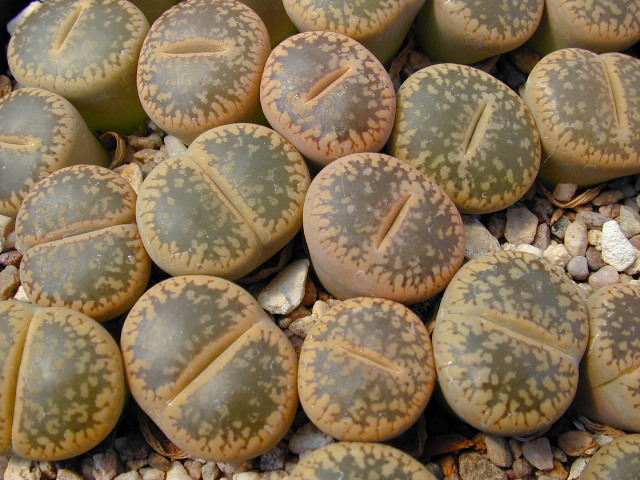
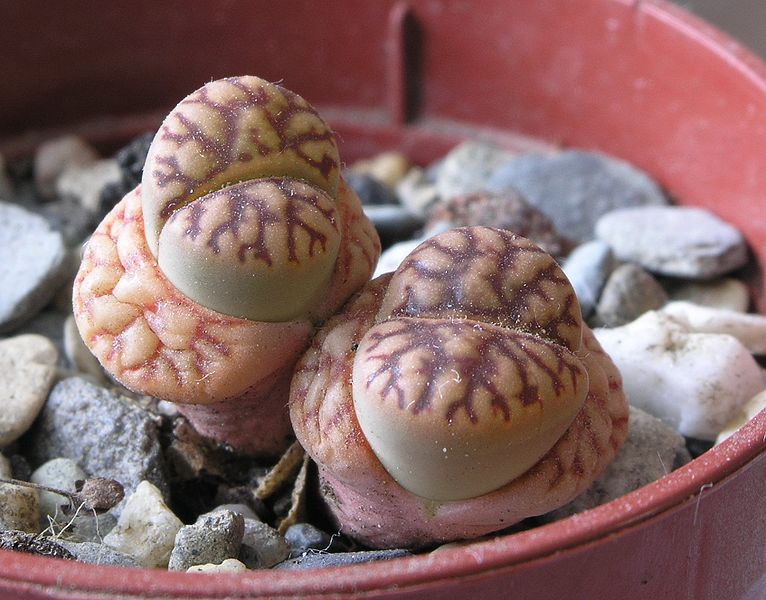
Lithops is a genus of succulent plants native to Southern Africa. "Lithos" means "stone" and "-ops" means "face" in Ancient Greek; therefore "Lithops" means "stone-like". The formation of the name from the Greek "ops" means that even a single plant is called a Lithops. This is a very good description of these plants, which avoid being eaten by blending in with surrounding rocks. They are also called ‘pebble plants’.

The genus Lithops is in the family of Aizoaceae, which also includes the various forms of plants known as "Ice Plants" and those called "Mimicry Plants". Lithops are commonly called Living Stones because of their remarkable resemblance to rocks on the ground. In a rock covered landscape, they are nearly indistinguishable from actual stones. In fact, the plant’s ability to blend in using its color and shape is the most startling adaptation of Living Stones. The leaves are not green as with many foliage plants, but various shades of cream, grey, brown, reddish browns, purplish browns, and grass-greens with a myriad of patterns such as darker windowed areas and designs, dots, red lines and areas known as "islands".

There are well over 300 types of Lithops. Several types differ in nearly all areas including texture, size and color. They may look similar, but are in fact very unique. No two Living Stone plants are going to look exactly alike. They are popular novelty house plants and many specialist succulent growers maintain collections.

Individual plants consist of one or more pairs of bulbous, nearly fused leaves opposite to each other and hardly any stem. The slit between the leaves contains the meristem and produces flowers and new leaves— leaves which are mostly buried below the surface of the soil. They have a characteristic top to the leaf which is a partially (or completely) translucent surface (or window) allowing light to enter the interior of the leaves for photosynthesis.

Lithops are extremely succulent bilobes (up to 90% water). A single body can be to 1.5" in diameter, and is split by a central "cleft", creating the "bi-lobed" body. Many species eventually form clusters, and in the native habitat, clusters gradually spread to from large colonies of Lithops that can span 6 feet in diameter. The rarer green forms occur naturally in grassy areas, while the browns, tans and other colors occur in quartz fields, providing an example of a phenomenon known as "mimicry" in which a plant, insect or animal can become almost completely camouflaged by its surroundings and is virtually undetectable. This ability to blend in helps Lithops avoid predators – The markings on the leaves disguise the plant in its surroundings from hungry animals that would otherwise feast on its tender, fleshy bodied leaves.

Climate: Lithops occur naturally across wide areas of Namibia and South Africa, as well as small bordering areas in Botswana and possibly Angola, from sea level to high mountains. Nearly a thousand individual populations are documented, each covering just a small area of dry grassland, veld, or bare rocky ground. Different Lithops species are preferentially found in particular environments, usually restricted to a particular type of rock. Lithops have not naturalized outside this region.

Rainfall in Lithops habitats ranges from approximately 700mm/year to near zero. Rainfall patterns range from exclusively summer rain to exclusively winter rain, with a few species relying almost entirely on dew formation for moisture. Temperatures are usually hot in summer and cool to cold in winter, but one species is found right at the coast with very moderate temperatures year round.

Lithops often survive many years of drought with nothing more than seasonal fogs. These plants have evolved a strategy that enables them to absorb and store moisture from these scant fogs. As our climate is much more humid than that of Africa, Lithops can absorb much of its required moisture from the air.

Growth Habit: Lithops tend to grow in the winter and rest in the summer, contrary to many other plants! During winter a new leaf pair, or occasionally more than one, grows inside the existing fused leaf pair. In spring the old leaf pair parts to reveal the new leaves and the old leaves will then dry up. The leaves may shrink and disappear below ground level during drought. Within their native habitat, plants almost never have more than one leaf pair per head, the environment is just too arid to support this. Yellow or white flowers emerge from the fissure between the leaves after the new leaf pair has fully matured, one per leaf pair. This is usually in autumn, but can be before the summer equinox in L. pseudotruncatella and after the winter equinox in L. optica. The flowers are often sweetly scented.

After the plant flowers, the plant will rest for a short time. Then from the middle again two new leaves will start to form. They will take all the moisture and nutrients from the old leaves. This is why it is important not to water/fertilize (it will disrupt the process). The old leaves will shrivel and die and the new ones will come in and replace the old ones. After that point in time it is safe to resume watering/fertilizing!

Lithops' fruit is a dry capsule that opens when it becomes wet; some seeds may be ejected by falling raindrops, and the capsule re-closes when it dries out. Capsules may also sometimes detach and be distributed intact, or may disintegrate after several years.

Summer Dormancy vs. Winter Growth: Normal treatment in mild temperate climates is to keep them completely dry during winter, watering only when the old leaves have dried up and been replaced by a new leaf pair. Watering continues through autumn when the plants flower and then stopped for winter. The best results are obtained with additional heat such as a greenhouse. In hotter climates, the plant will have a summer dormancy when they should be kept mostly dry, and they may require some water in winter. In tropical climates, Lithops can be grown primarily in winter with a long summer dormancy. In all conditions, Lithops will be most active and need most water during autumn and each species will flower at approximately the same time.

Soil Type: Lithops thrive best in a coarse, well-drained substrate. Any soil that retains too much water will cause the plants to burst their skins as they over-expand. Plants grown in strong light will develop hard strongly colored skins which are resistant to damage and rot, although persistent overwatering will still be fatal. Excessive heat will kill potted plants as they cannot cool themselves by transpiration and rely on staying buried in cool soil below the surface.

Lithops requires a porous soil; note that very excellent drainage can be attained by the addition of extra pumice or other coarse material. It is preferable that the soil does not contain much organic material, such as peat moss and that the plant is not fertilized with heavy nitrogen as this can cause an explosion of soft, flabby growth that can make the plant prone to bacterial rots. Another good mix would be 40% peat moss and 60% perlite to allow even faster drainage.

What pot should I use for my Living Stones? In my opinion, plastic or terracotta pots are best. Since Living Stones are a succulent, a terracotta pot will not only fit the succulent theme (sand, rocks, deserts, etc) but also might help the plant dry out a bit easier. Since terracotta is porous, water goes through it easily, helping the pot dry out as well as the plant – especially if it’s in a sunny location! You could also use a glazed pot if you desire. In design terms, a glass container would look striking and allow you to watch the plants’ roots grow and develop—a very cool idea, indeed! Just be sure the glass container has a drainage hole. Many glass containers do NOT normally have a drainage hole, so please be cautious!

Light: Lithops requires full to very bright sun (either direct or indirect). Shade will kill this plant! It can take full strength sun, but be mindful of sun burning the leaves (I know this from personal experience). If your plant is in full sun, be sure to water every week (instead of every two--see below).

A window facing West, South or East should do nicely. Too much light is not a problem for Living Stones. Too little light is! If the plant appears to be 'reaching' for the window or light source, it needs more light! Stretching will cause the Living Stones to lose their rock like appearance and grow taller. If this begins happening, simply find another place with more light.

In the wintertime during active growth, you may want to move Living Stones closer to a window – they need as much light as possible when producing new leaves. The rest of the year, they still need sufficient light, but even if they aren’t right next to a window, be sure they can get some bright sunlight. Where you place your plants really depends on your window access (a house may have several whereas an apartment or other place may have only one or two) and your available space for plants. If you’re already obsessed with plants, the chances are good your space may be limited! The good news is: Living Stones tend to be small kept singly or in clusters. Plants grow slowly and don’t need huge pots or containers. If your plant space is limited, Living Stones may be a plant for you!

Watering: Keep plants barely moist! Overwatering is the most common problem people have with Living Stones. Overwatering will result in the death of this plant 9 times out of 10. One Lithops expert once remarked in regard to watering Lithops: "When in doubt, don't". During the cold winter months, watering should be light and infrequent once again, until such as time as the days grow longer and the temperature begins to warm a bit.

Generally, Lithops will do best being watered about once every two or three weeks (when not in active growth or flowering). Tap water or distilled water is fine. Treat it as a cactus. The plant can take a 'misting' every other day if desired, but this is not required. Be sure not to overwater! It will take up all the water that is put in the pot, even if its too much!

This next part is very important!!  Keep in mind, watering requirements will change throughout the year depending on which season you are currently in!! Lithops is a very unique succulent with unique watering requirements. Since overwatering is the number one cause of death for Lithops, it’s imperative growers learn exactly when (and when not) to water. For this reason, keeping these plants alive takes a bit of time and skill!

Spring:
The plant is dormant now. Water only if the leaves appear wrinkled.


Summer:
During the hot summer months the plants will be dormant and watering should be light and infrequent, only enough should be given to prevent the plants from shriveling or appearing "wrinkled".

Fall:
After the hottest part of summer, as autumn approaches, the plant will use most of its stored energies to flower. The appearance of buds signals the start of another watering period. Plants should be watered enough during this time that the bodies remain turgid, or, in other words, do not become "wrinkled". Watering should be thorough, but less frequently than for other succulents.

After the flower dies off, ALL WATERING/FERTILIZING SHOULD BE STOPPED!!

Winter:
Water should be withheld as the new leaves begin to appear in the cleft during winter time. You must do this so that newly forming leaves are allowed to absorb the moisture from the old leaves, or the plant will be more prone to rot and the new plant formed will be smaller than before, rather than growing larger as it should. When it is apparent that the new leaves have absorbed the moisture from the old leaves ~ nothing but a dry husk will remain of the old leaves ~ that is the signal that it is time to begin watering normally again.

What happens if I overwater?
If you have consistently overwatered Living Stones, it will likely die, especially if planted in the wrong kind of soil (soil that retains lots of water, such as peat moss). If you’ve only overwatered once or twice, the plant will fill itself with water and ‘bulge’ out. Anymore water at this point can burst the leaves. Your best option is to withhold watering again until the leaves have once more reduced to normal size. Water thoroughly when soil is dry to the touch during the active growing periods. If the plant is shriveled during the non-growing periods, water a very little bit, just so the leaves perk up.

I repeat, if too much water is given at ANY time, the plant will swell and then split. If this happens, you cannot go back!! Take care when watering, and water sparingly. Take note of the seasons, and be confident in your Green Thumb!

Temperature: Living Stones will do fine in just about any temperature that it is given. Naturally found in the deserts of South Africa, the plant will do fine with hotter temperatures. Lithops are somewhat cold tolerant, but it is advisable to provide frost protection to prevent possible scarring. Colder temperatures are okay, but by no means ideal. Do not allow your plant to freeze. If this happens, the plant will die. Lithops prefers a wide spectrum of temperatures above 50 degrees, pushing into the 90-100 degree range (that being the absolute hottest the plant can handle). Ideally, you want your plant to thrive at a temperature around 65 to 75 degrees.

Flowering: Flowers appear from August to November, depending upon the species, and usually open in late afternoon, but open on multiple days. At this time, the plant is nearly obscured by flower heads to 1" in diameter that are composed of frilly, satiny yellow or white petals.

Living Stones will typically bloom in the fall. A blooming plant means it is at least 2 to 3 years old (juvenile plants cannot bloom since they need a ton of energy to do so). Only mature plants that are well cared for will bloom. Often times Living Stones only bloom in greenhouse environments or for professional growers. If your plant does bloom, it must like its location and current conditions! Daisy-like flowers of white or yellow last about a week and then die. Give the plant no water or fertilizer when it’s flowering, as this will interrupt the natural cycle (something you should avoid!)

Propagation: Propagation of Lithops is best done by seed or cuttings. Cuttings can only be used to produce new plants after a plant has naturally divided to form multiple heads, so most propagation is by seed. Lithops can readily be pollinated by hand, and seed will be ripe about 9 months later. Seed is easy to germinate, but the seedlings are small and vulnerable for the first year or two.

Fertilization: Fertilizer is a requirement that is of some debate with growers. To play it safe use a diluted amount of 20-20-20 plant food (about 1/4 strength) will be fine about once a month. Do not exceed this amount! After the plant flowers in late fall/early winter, no fertilizer should be applied to the plant until after the new growth comes in.

Reproduction: Living Stones will reproduce themselves by runner (a 'root' that will spread out). A new plant will come up (usually by the parent.)

Do’s and Dont’s:
Do not water or fertilize your plant when it is producing new leaves. This will disrupt the process which it needs to complete uninterrupted at this time.

Do not overwater your plant. It will swell and sometimes split. If this happens special chemicals will need to be applied so that bacteria does not enter the plant and cause it to die. If this is not done in time, the plant must be discarded and replaced.

Do give Lithops adequate fresh air and bright, indirect light. Full sun is excellent when and if the plant(s) are properly acclimated to the sunlight. If they have been grown in partial sun before being moved, move them steadily up to the window a little at a time over a period of about 2 weeks or so. By the end of 2 weeks, the plant will be fully acclimated to a full sun environment and will likely not sun burn!

In all, Lithops may seem like a daunting plant to successfully grow in the home, but with the proper education and patience, you can (and will) succeed. Pay attention closely to the watering requirements with this plant. I cannot over state this enough! If you have any questions about Lithops or other succulents, please email me at: espressomocha86@hotmail.com Please include pictures of the plant(s) in question if at all possible! Friend me on Facebook at: www.facebook.com/eirinn.cunningham

Leave me a comment below this post! I appreciate your readership!! I hope your day is truly amazing…May your plants enrich and restore your spirit!

Dec 23, 2010

All About Yule Article

Here is a short article with lots of information about the Pagan Yule, or Winter Solstice. Though is has officially passed, beef up some knowledge so you can know about it for next year!

All About Yule

Dec 22, 2010

A Very Brief History of Jesus

I can't help but mention Jesus at a time so close to Christmas! December the 25th is thought to be Jesus' official day of birth. As you will discover, that date is really more conjecture at this point than actual historical fact.

Jesus of Nazareth is thought to have lived from around the year 5 CE (or common era) to the year 33 CE. He is the central figure of Christianity. Christians view him as the Messiah foretold in the Old Testament, and as the Son of God. Christians traditionally believe that Jesus was born of The Virgin Mary, performed miracles, founded the Church, rose from the dead, and ascended into heaven. The majority of Christians worship Jesus as the incarnation of God the Son, of the divine Trinity (The Father, The Son and The Holy Spirit). Jesus is thought be both a human man and a divine figure (as the Son of God).

In the year 33, Jesus was crucified (upon orders from the Roman Prefect of Judaea, Pontius Pilate), on Mt. Golgotha, in Jerusalem, along with two other people, who were both thieves. The charge against him was sedition against the Roman Empire. The Crucifixion happened on a Friday (what is now Good Friday). Upon his death, Jesus’ side was pierced by a lance (from which flowed blood and water) to make certain he had died. Later, he was entombed.

On what is now Easter Sunday, it is said Jesus rose from the dead and was taken into Heaven to sit at the right side of God the Father. The only witness to this resurrection miracle was Mary Magdalene. She alone went into the tomb, finding it wide open, and Jesus’ body missing. All that was left behind was the shroud in which Jesus had lay dead. Today, the Shroud of Turin (thought to be the actual shroud Jesus was entombed in) can be seen inside the royal chapel of the Cathedral of Saint John the Baptist in Turin, Northern Italy.

Christians and Catholics alike reflect on the story of the Crucifixion whenever they think about the concept of sin. Jesus was crucified and died for the sins of all humankind. His death provided salvation and also allowed for a reconciliation with God.

The birth of Jesus is celebrated as a national holiday in the United States each December 25th, but is observed and recognized worldwide. The date is not known to be the actual birthday of Jesus, and may have initially been chosen for any number of reasons: 1. to correspond with either the day exactly nine months after some early Christians believed Jesus had been conceived 2. as the date of the Roman winter solstice, or 3. as one of various ancient winter festivals celebrated at that time.

In my opinion, the Catholic Church decreed his birthday celebration be moved to the Winter Solstice in order to correspond with the pagan festival of Yule. December was likely not the actual birth time of Jesus, despite common misconceptions on this point. In fact, scholars today believe Jesus would have most likely been born some time in the Summer, rather than in Winter.

There is much debate regarding the Bible on many things, but particularly with these questions:

1. How much of the Bible is factual history?
2. How many of the Bible stories can be verified through written accounts or archaeological evidence?
3. How much content is conjectural rather than historically accurate?
4. Which books of the Bible that describe events in Jesus’ life are 100% historically accurate?

I will not attempt an answer to all these questions. But, as to the final question, I will say we will never really know for sure! I believe all the Gospels which mention Jesus must be studied in order to fully understand the scope of Jesus’ life. Each contains a kernel of the real truth of Jesus, both the man and the divine.

The Gospels of Matthew, Mark, Luke and John give us the clearest pictures of Jesus’ life. In my opinion, all the writers of these books have something important to say about Jesus. It’s only when we piece all this information together into one bigger picture that we even come close to finding the answer to the ultimate question: “Who was the real Jesus?”