Feb 5, 2011

The Weed of Death


Currently, I live in Westland, Michigan with my boyfriend of 4 years, Kenny. We are both renting a place right now, and let me tell you – the property has some of its own ‘planty’ surprises! During the growing season, we are faced with the horror that is…unspeakable! I’m so distraught by its fury I can’t even talk about it!

Ok, there. I took a deep breath. It’s a truly nasty surprise noticeable in the late spring and all summer long: False Bindweed, also known as the Morning Glory Vine or Hedge Bindweed. Its scientific name is Calystegia spp.

This demon is an invasive weed that winds around other plant stems clockwise …and kills them. Anything you have growing nearby that it decides to attack will die, if the weed is given free reign and enough time to perform its hideous murder!

…Bushes are fair game. Small tress and mature and trees alike are fair game. Watch out! If you notice Bindweed near any plants you want to keep—take action now—before it’s too late!!

About Morning Glory Vine

This weedy perennial vine will twine all over the garden, covering your ornamental plants to the point of smothering them. It is usually introduced by seed or invasive roots from under the neighbor's fence. Its success as a weed lies in its thick fleshy roots which travel long distances just under the soil surface. Since morning glory is a perennial weed, control lies in removing the root system. Hand weeding can remove large quantities of roots, but any broken pieces are capable of sprouting new growth. Repeated, persistent digging as the new growth sprouts can deplete the food reserves. If chemical control is required, cut back the growth and apply the material to leaves or stems in as localized a fashion as possible.

The Weed From Hell
One man’s fight with The Weed of Death is revealed below. Eventually he was able to win the battle, even when it seemed the odds were most certainly against him! But it didn’t come without a cost…Time, lots and lots of time!

Gardening is close to impossible when it gets this well established, as the massive root system of the plant goes about 15 foot deep and can throw out endless meters of plant growth all summer. I've seen it scale to the top of a 5 foot fence in just three days. Of all the weeds I've had in my garden, this one is the weed from Hell.

The main problem with bindweed is the massive deep root network, so if you kill that the result should be good. Glyphosate weed killers (like roundup) are taken in to the roots of weeds and kill them, so I tried them first and discovered that they didn't have lasting effects on such a large plant. The quantity absorbed by the foliage isn't enough to kill the main root system, it's just too big, and increasing the concentration of glyphosate would cause the foliage to die faster and quickly cut off the absorption. What you need is slow poisoning, that way the plant and it's vast roots will absorb as much glyphosate as possible before it becomes terminal.

I collected the long strands of bindweed and wrapped them up in balls that I placed inside old jars and tin cans. These I filled with a glyphosate based weed killer, but I mixed it with about 1/3 more water than the instructions suggested, then I covered them over with plastic which I taped down firmly to keep animals and rain out. Do be aware that if these are knocked over and spilt on to plants you want they will die, so it's advisable to keep them at a distance and partly bury them in the ground for stability.

It takes time, but I could clearly see the level in the containers reducing as the plant absorbed it. This seemed to work faster in the hot weather as the plant would be drawing more water, and also not removing the new bindweed shoots as they emerge since their growing is causing the plant to soak up more weed killer, and also these shoots will be your next place to attach another can of solution when the old ones die off. For the first couple of months I saw no effect, although the bindweed had sucked in several pints of weed killer, but then it started to slow down, and after a while I noticed the new growth was an unhealthy yellow color with holes in the misshapen leaves. About four months after starting this the main root system must have collapsed as the plant just withered away, even the bindweed across the road died (must have been one huge plant under the garden/road). It did continue to sprout the very occasional sickly yellow shoot, but a quick spray of weed killer dealt with them nicely.

In the end, it took roughly 2-3 years to kill the entire root system! Calystegia has a huge root system; the real trick is to get to it early or it can be very hard to control. Digging up the weed, the masses of root were as big around as my thigh and traveling the entire length of the home’s cement foundation!

Methods of Control
1. Dig what you can, treat any new growth sprouting immediately with Roundup. Be consistent, complete removal may take a year or two.

2. Fill a small container with roundup. Cut a small hole or slit in the top and stick one of the vines in the container (through the hole in the top). Place the container in an area where it won't get knocked over or disturbed. Watch and wait for the plant to die. You may need to do this several times to kill it all. The idea is to let the plant soak up lots and lots of roundup (far more than what it would soak up from the leaves.) It is VERY important that the container of RU be in a safe spot where kids and animals won't get into it or knock it over.

3. Also another method is to hand pull all old growth you can find, then apply roundup to any new growth. (Just by spraying or painting this time) Newer growth is far more susceptible to herbicides.

Moving Outdoors/Repotting/Container Notes

Here are some helpful plant related notes that I wanted to share with everyone! Happy readings!

Moving Houseplants Outdoors

1. Summer is a good time to put plants outdoors…repotting is also a good idea at this time!

2. Straighten plants when repotting during the summer if they appear to be leaning

3. Use a plastic pot to protect more decorative plant pots (esp. plants that will be outdoors)

4. If you notice any pests, spray them with an insecticidal soap outdoors

5. Leave treated plants outdoors for at least 3 days before bringing inside again

6. Be sure to keep them away from other plants if they turn out to be afflicted

7. Put plants in a shady place, not full sun—the leaves will scorch if you aren’t careful!


Repotting Tips:

1. Spring is a great time for repotting, as is summertime

2. Breaking the pot is sometimes necessary (although this is rare), so don’t be afraid to do this if you absolutely have to!

3. Potsherds can be used for increasing drainage beneath a plant’s rootball

4. Be sure to wash away salt buildup occurring from fertilization. Flush the pot outdoors with lots of water whenever you see salt crystals on the soil surface

5. Loosen the roots before repotting so you can redirect them into the new soil. This step is extra, but very beneficial to a plant’s health over time.

6. Cut stubborn roots away – this will help with newer growth and encourage new roots to form

7. Layer soil around the root ball, and then water the plant

8. The soil will settle into the new pot on its own; don’t compress the soil by hand, or you will close air pockets within soil that let roots breathe!

Containers: Terracotta

1. Terracotta is a classic material for plant pots

2. Expensive terracotta is softer and more porous. It’s very fragile and will break if dropped. You don’t want an investment like this to break!

3. Water collects in the pores of the clay and freezes—then expands—after which point it will shatter. Protecting both the plant and pot from freezing temperatures is advisable!

4. Higher grade terracotta is much denser and more durable than lower grade

5. Apply a water sealer on the inside of the pot to help preserve it for many years

6. Use a plastic nursery container to place the plant in instead of putting it into the actual pot. This will help protect the pot over a long time period

Jan 21, 2011

Lithops 101

Lithops spp. (Living Stones)

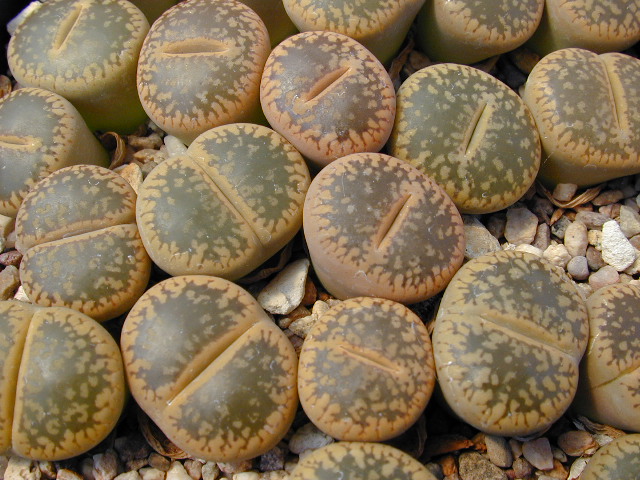
Lithops is a genus of succulent plants native to Southern Africa. "Lithos" means "stone" and "-ops" means "face" in Ancient Greek; therefore "Lithops" means "stone-like". The formation of the name from the Greek "ops" means that even a single plant is called a Lithops. This is a very good description of these plants, which avoid being eaten by blending in with surrounding rocks. They are also called ‘pebble plants’.

The genus Lithops is in the family of Aizoaceae, which also includes the various forms of plants known as "Ice Plants" and those called "Mimicry Plants". Lithops are commonly called Living Stones because of their remarkable resemblance to rocks on the ground. In a rock covered landscape, they are nearly indistinguishable from actual stones. In fact, the plant’s ability to blend in using its color and shape is the most startling adaptation of Living Stones. The leaves are not green as with many foliage plants, but various shades of cream, grey, brown, reddish browns, purplish browns, and grass-greens with a myriad of patterns such as darker windowed areas and designs, dots, red lines and areas known as "islands".

There are well over 300 types of Lithops. Several types differ in nearly all areas including texture, size and color. They may look similar, but are in fact very unique. No two Living Stone plants are going to look exactly alike. They are popular novelty house plants and many specialist succulent growers maintain collections.

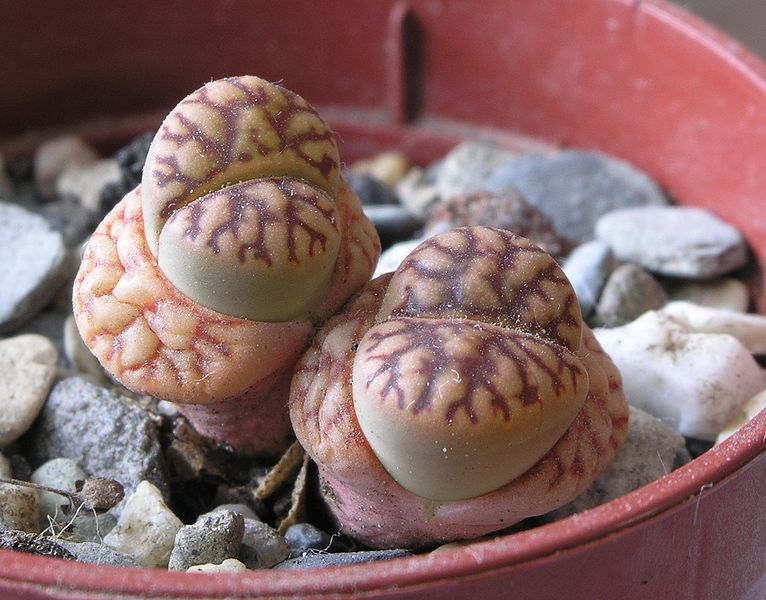
Individual plants consist of one or more pairs of bulbous, nearly fused leaves opposite to each other and hardly any stem. The slit between the leaves contains the meristem and produces flowers and new leaves— leaves which are mostly buried below the surface of the soil. They have a characteristic top to the leaf which is a partially (or completely) translucent surface (or window) allowing light to enter the interior of the leaves for photosynthesis.

Lithops are extremely succulent bilobes (up to 90% water). A single body can be to 1.5" in diameter, and is split by a central "cleft", creating the "bi-lobed" body. Many species eventually form clusters, and in the native habitat, clusters gradually spread to from large colonies of Lithops that can span 6 feet in diameter. The rarer green forms occur naturally in grassy areas, while the browns, tans and other colors occur in quartz fields, providing an example of a phenomenon known as "mimicry" in which a plant, insect or animal can become almost completely camouflaged by its surroundings and is virtually undetectable. This ability to blend in helps Lithops avoid predators – The markings on the leaves disguise the plant in its surroundings from hungry animals that would otherwise feast on its tender, fleshy bodied leaves.

Climate: Lithops occur naturally across wide areas of Namibia and South Africa, as well as small bordering areas in Botswana and possibly Angola, from sea level to high mountains. Nearly a thousand individual populations are documented, each covering just a small area of dry grassland, veld, or bare rocky ground. Different Lithops species are preferentially found in particular environments, usually restricted to a particular type of rock. Lithops have not naturalized outside this region.

Rainfall in Lithops habitats ranges from approximately 700mm/year to near zero. Rainfall patterns range from exclusively summer rain to exclusively winter rain, with a few species relying almost entirely on dew formation for moisture. Temperatures are usually hot in summer and cool to cold in winter, but one species is found right at the coast with very moderate temperatures year round.

Lithops often survive many years of drought with nothing more than seasonal fogs. These plants have evolved a strategy that enables them to absorb and store moisture from these scant fogs. As our climate is much more humid than that of Africa, Lithops can absorb much of its required moisture from the air.

Growth Habit: Lithops tend to grow in the winter and rest in the summer, contrary to many other plants! During winter a new leaf pair, or occasionally more than one, grows inside the existing fused leaf pair. In spring the old leaf pair parts to reveal the new leaves and the old leaves will then dry up. The leaves may shrink and disappear below ground level during drought. Within their native habitat, plants almost never have more than one leaf pair per head, the environment is just too arid to support this. Yellow or white flowers emerge from the fissure between the leaves after the new leaf pair has fully matured, one per leaf pair. This is usually in autumn, but can be before the summer equinox in L. pseudotruncatella and after the winter equinox in L. optica. The flowers are often sweetly scented.

After the plant flowers, the plant will rest for a short time. Then from the middle again two new leaves will start to form. They will take all the moisture and nutrients from the old leaves. This is why it is important not to water/fertilize (it will disrupt the process). The old leaves will shrivel and die and the new ones will come in and replace the old ones. After that point in time it is safe to resume watering/fertilizing!

Lithops' fruit is a dry capsule that opens when it becomes wet; some seeds may be ejected by falling raindrops, and the capsule re-closes when it dries out. Capsules may also sometimes detach and be distributed intact, or may disintegrate after several years.

Summer Dormancy vs. Winter Growth: Normal treatment in mild temperate climates is to keep them completely dry during winter, watering only when the old leaves have dried up and been replaced by a new leaf pair. Watering continues through autumn when the plants flower and then stopped for winter. The best results are obtained with additional heat such as a greenhouse. In hotter climates, the plant will have a summer dormancy when they should be kept mostly dry, and they may require some water in winter. In tropical climates, Lithops can be grown primarily in winter with a long summer dormancy. In all conditions, Lithops will be most active and need most water during autumn and each species will flower at approximately the same time.

Soil Type: Lithops thrive best in a coarse, well-drained substrate. Any soil that retains too much water will cause the plants to burst their skins as they over-expand. Plants grown in strong light will develop hard strongly colored skins which are resistant to damage and rot, although persistent overwatering will still be fatal. Excessive heat will kill potted plants as they cannot cool themselves by transpiration and rely on staying buried in cool soil below the surface.

Lithops requires a porous soil; note that very excellent drainage can be attained by the addition of extra pumice or other coarse material. It is preferable that the soil does not contain much organic material, such as peat moss and that the plant is not fertilized with heavy nitrogen as this can cause an explosion of soft, flabby growth that can make the plant prone to bacterial rots. Another good mix would be 40% peat moss and 60% perlite to allow even faster drainage.

What pot should I use for my Living Stones? In my opinion, plastic or terracotta pots are best. Since Living Stones are a succulent, a terracotta pot will not only fit the succulent theme (sand, rocks, deserts, etc) but also might help the plant dry out a bit easier. Since terracotta is porous, water goes through it easily, helping the pot dry out as well as the plant – especially if it’s in a sunny location! You could also use a glazed pot if you desire. In design terms, a glass container would look striking and allow you to watch the plants’ roots grow and develop—a very cool idea, indeed! Just be sure the glass container has a drainage hole. Many glass containers do NOT normally have a drainage hole, so please be cautious!

Light: Lithops requires full to very bright sun (either direct or indirect). Shade will kill this plant! It can take full strength sun, but be mindful of sun burning the leaves (I know this from personal experience). If your plant is in full sun, be sure to water every week (instead of every two--see below).

A window facing West, South or East should do nicely. Too much light is not a problem for Living Stones. Too little light is! If the plant appears to be 'reaching' for the window or light source, it needs more light! Stretching will cause the Living Stones to lose their rock like appearance and grow taller. If this begins happening, simply find another place with more light.

In the wintertime during active growth, you may want to move Living Stones closer to a window – they need as much light as possible when producing new leaves. The rest of the year, they still need sufficient light, but even if they aren’t right next to a window, be sure they can get some bright sunlight. Where you place your plants really depends on your window access (a house may have several whereas an apartment or other place may have only one or two) and your available space for plants. If you’re already obsessed with plants, the chances are good your space may be limited! The good news is: Living Stones tend to be small kept singly or in clusters. Plants grow slowly and don’t need huge pots or containers. If your plant space is limited, Living Stones may be a plant for you!

Watering: Keep plants barely moist! Overwatering is the most common problem people have with Living Stones. Overwatering will result in the death of this plant 9 times out of 10. One Lithops expert once remarked in regard to watering Lithops: "When in doubt, don't". During the cold winter months, watering should be light and infrequent once again, until such as time as the days grow longer and the temperature begins to warm a bit.

Generally, Lithops will do best being watered about once every two or three weeks (when not in active growth or flowering). Tap water or distilled water is fine. Treat it as a cactus. The plant can take a 'misting' every other day if desired, but this is not required. Be sure not to overwater! It will take up all the water that is put in the pot, even if its too much!

This next part is very important!!  Keep in mind, watering requirements will change throughout the year depending on which season you are currently in!! Lithops is a very unique succulent with unique watering requirements. Since overwatering is the number one cause of death for Lithops, it’s imperative growers learn exactly when (and when not) to water. For this reason, keeping these plants alive takes a bit of time and skill!

Spring:
The plant is dormant now. Water only if the leaves appear wrinkled.


Summer:
During the hot summer months the plants will be dormant and watering should be light and infrequent, only enough should be given to prevent the plants from shriveling or appearing "wrinkled".

Fall:
After the hottest part of summer, as autumn approaches, the plant will use most of its stored energies to flower. The appearance of buds signals the start of another watering period. Plants should be watered enough during this time that the bodies remain turgid, or, in other words, do not become "wrinkled". Watering should be thorough, but less frequently than for other succulents.

After the flower dies off, ALL WATERING/FERTILIZING SHOULD BE STOPPED!!

Winter:
Water should be withheld as the new leaves begin to appear in the cleft during winter time. You must do this so that newly forming leaves are allowed to absorb the moisture from the old leaves, or the plant will be more prone to rot and the new plant formed will be smaller than before, rather than growing larger as it should. When it is apparent that the new leaves have absorbed the moisture from the old leaves ~ nothing but a dry husk will remain of the old leaves ~ that is the signal that it is time to begin watering normally again.

What happens if I overwater?
If you have consistently overwatered Living Stones, it will likely die, especially if planted in the wrong kind of soil (soil that retains lots of water, such as peat moss). If you’ve only overwatered once or twice, the plant will fill itself with water and ‘bulge’ out. Anymore water at this point can burst the leaves. Your best option is to withhold watering again until the leaves have once more reduced to normal size. Water thoroughly when soil is dry to the touch during the active growing periods. If the plant is shriveled during the non-growing periods, water a very little bit, just so the leaves perk up.

I repeat, if too much water is given at ANY time, the plant will swell and then split. If this happens, you cannot go back!! Take care when watering, and water sparingly. Take note of the seasons, and be confident in your Green Thumb!

Temperature: Living Stones will do fine in just about any temperature that it is given. Naturally found in the deserts of South Africa, the plant will do fine with hotter temperatures. Lithops are somewhat cold tolerant, but it is advisable to provide frost protection to prevent possible scarring. Colder temperatures are okay, but by no means ideal. Do not allow your plant to freeze. If this happens, the plant will die. Lithops prefers a wide spectrum of temperatures above 50 degrees, pushing into the 90-100 degree range (that being the absolute hottest the plant can handle). Ideally, you want your plant to thrive at a temperature around 65 to 75 degrees.

Flowering: Flowers appear from August to November, depending upon the species, and usually open in late afternoon, but open on multiple days. At this time, the plant is nearly obscured by flower heads to 1" in diameter that are composed of frilly, satiny yellow or white petals.

Living Stones will typically bloom in the fall. A blooming plant means it is at least 2 to 3 years old (juvenile plants cannot bloom since they need a ton of energy to do so). Only mature plants that are well cared for will bloom. Often times Living Stones only bloom in greenhouse environments or for professional growers. If your plant does bloom, it must like its location and current conditions! Daisy-like flowers of white or yellow last about a week and then die. Give the plant no water or fertilizer when it’s flowering, as this will interrupt the natural cycle (something you should avoid!)

Propagation: Propagation of Lithops is best done by seed or cuttings. Cuttings can only be used to produce new plants after a plant has naturally divided to form multiple heads, so most propagation is by seed. Lithops can readily be pollinated by hand, and seed will be ripe about 9 months later. Seed is easy to germinate, but the seedlings are small and vulnerable for the first year or two.

Fertilization: Fertilizer is a requirement that is of some debate with growers. To play it safe use a diluted amount of 20-20-20 plant food (about 1/4 strength) will be fine about once a month. Do not exceed this amount! After the plant flowers in late fall/early winter, no fertilizer should be applied to the plant until after the new growth comes in.

Reproduction: Living Stones will reproduce themselves by runner (a 'root' that will spread out). A new plant will come up (usually by the parent.)

Do’s and Dont’s:
Do not water or fertilize your plant when it is producing new leaves. This will disrupt the process which it needs to complete uninterrupted at this time.

Do not overwater your plant. It will swell and sometimes split. If this happens special chemicals will need to be applied so that bacteria does not enter the plant and cause it to die. If this is not done in time, the plant must be discarded and replaced.

Do give Lithops adequate fresh air and bright, indirect light. Full sun is excellent when and if the plant(s) are properly acclimated to the sunlight. If they have been grown in partial sun before being moved, move them steadily up to the window a little at a time over a period of about 2 weeks or so. By the end of 2 weeks, the plant will be fully acclimated to a full sun environment and will likely not sun burn!

In all, Lithops may seem like a daunting plant to successfully grow in the home, but with the proper education and patience, you can (and will) succeed. Pay attention closely to the watering requirements with this plant. I cannot over state this enough! If you have any questions about Lithops or other succulents, please email me at: espressomocha86@hotmail.com Please include pictures of the plant(s) in question if at all possible! Friend me on Facebook at: www.facebook.com/eirinn.cunningham

Leave me a comment below this post! I appreciate your readership!! I hope your day is truly amazing…May your plants enrich and restore your spirit!

Dec 23, 2010

All About Yule Article

Here is a short article with lots of information about the Pagan Yule, or Winter Solstice. Though is has officially passed, beef up some knowledge so you can know about it for next year!

All About Yule

Dec 22, 2010

A Very Brief History of Jesus

I can't help but mention Jesus at a time so close to Christmas! December the 25th is thought to be Jesus' official day of birth. As you will discover, that date is really more conjecture at this point than actual historical fact.

Jesus of Nazareth is thought to have lived from around the year 5 CE (or common era) to the year 33 CE. He is the central figure of Christianity. Christians view him as the Messiah foretold in the Old Testament, and as the Son of God. Christians traditionally believe that Jesus was born of The Virgin Mary, performed miracles, founded the Church, rose from the dead, and ascended into heaven. The majority of Christians worship Jesus as the incarnation of God the Son, of the divine Trinity (The Father, The Son and The Holy Spirit). Jesus is thought be both a human man and a divine figure (as the Son of God).

In the year 33, Jesus was crucified (upon orders from the Roman Prefect of Judaea, Pontius Pilate), on Mt. Golgotha, in Jerusalem, along with two other people, who were both thieves. The charge against him was sedition against the Roman Empire. The Crucifixion happened on a Friday (what is now Good Friday). Upon his death, Jesus’ side was pierced by a lance (from which flowed blood and water) to make certain he had died. Later, he was entombed.

On what is now Easter Sunday, it is said Jesus rose from the dead and was taken into Heaven to sit at the right side of God the Father. The only witness to this resurrection miracle was Mary Magdalene. She alone went into the tomb, finding it wide open, and Jesus’ body missing. All that was left behind was the shroud in which Jesus had lay dead. Today, the Shroud of Turin (thought to be the actual shroud Jesus was entombed in) can be seen inside the royal chapel of the Cathedral of Saint John the Baptist in Turin, Northern Italy.

Christians and Catholics alike reflect on the story of the Crucifixion whenever they think about the concept of sin. Jesus was crucified and died for the sins of all humankind. His death provided salvation and also allowed for a reconciliation with God.

The birth of Jesus is celebrated as a national holiday in the United States each December 25th, but is observed and recognized worldwide. The date is not known to be the actual birthday of Jesus, and may have initially been chosen for any number of reasons: 1. to correspond with either the day exactly nine months after some early Christians believed Jesus had been conceived 2. as the date of the Roman winter solstice, or 3. as one of various ancient winter festivals celebrated at that time.

In my opinion, the Catholic Church decreed his birthday celebration be moved to the Winter Solstice in order to correspond with the pagan festival of Yule. December was likely not the actual birth time of Jesus, despite common misconceptions on this point. In fact, scholars today believe Jesus would have most likely been born some time in the Summer, rather than in Winter.

There is much debate regarding the Bible on many things, but particularly with these questions:

1. How much of the Bible is factual history?
2. How many of the Bible stories can be verified through written accounts or archaeological evidence?
3. How much content is conjectural rather than historically accurate?
4. Which books of the Bible that describe events in Jesus’ life are 100% historically accurate?

I will not attempt an answer to all these questions. But, as to the final question, I will say we will never really know for sure! I believe all the Gospels which mention Jesus must be studied in order to fully understand the scope of Jesus’ life. Each contains a kernel of the real truth of Jesus, both the man and the divine.

The Gospels of Matthew, Mark, Luke and John give us the clearest pictures of Jesus’ life. In my opinion, all the writers of these books have something important to say about Jesus. It’s only when we piece all this information together into one bigger picture that we even come close to finding the answer to the ultimate question: “Who was the real Jesus?”

Which Plants Do I Own?


What's the story behind my plant collection?
My plant collection is large and varied, from foliage plants to flowering plants, to cacti and succulents. Some plants were gifted to me, while most others I just bought on my own. A typical scenario when out shopping goes like this: I see a particular plant in a store that looks amazing and say to myself,  "I have got to have one of those!" I really do have a plant addiction, in the same way I am addicted to buying books!

Bitten by the plant bug!
I think I can safely blame my Mom for helping me grow in my interests with plants in general, especially over the past couple years. My Grandma Durecki is the person that originally passed her love of plants to both my Mom and my Aunt Colleen. Now I wish I'd had the chance to talk plants with Grandma before she passed away - of course a ten year old (my age then) isn't usually too interested in plants!

Additionally, while living with my boyfriend of 4 years (his name is Kenny) I come into contact with plants a lot, so the oportunity for finding a new green friend does arise from time to time. Kenny's Mom loves to keep plants, as does his Grandma Browning. Grandma has given me a cactus and my Flaming Katy plant, although she was not sure exactly what type of plant it was, until I googled it! Thank you, Google!

My best friend Brie is also familiar with many different plants, as she works with them daily. She also owns several, including Living Stones, Philodendron, and Christmas Cactus. We talk about plants all the time! I'll say it's certainly a favorite thing to do!

Almost all my plants are indoors, but a few of them do enjoy the occasional summer hiatus. I have a few outdoor flowering plants in the ground, none of which are currently doing anything, except for the Mums (which bloom in the wintertime). Even now, the mum's have finally wilted away. Winter is certainly here in Michigan! I divided the plants into 2 sections: indoor and outdoor.

My Plant Collection Inside the House
English Ivy (Hedera helix) - See the picture to the right. This plant is just over two years old now. We got it from Kenny's friend at work around Samhain 2008 (Oct. 31).

Many, many African Violets (Saintpaulia). These are without a doubt a sort-of-new favorite. I have officially gone nuts with the propagation of these beautiful African flowering plants. They can be temperamental at times, but are extremely rewarding and fairly hardy. The reward truly lies is a successful bloom. If given the proper care, AV's will flower several times throughout the year -- even in the dead of winter! There's nothing like an AV in bloom to bring some joy to your home amidst the frozen, snowy cold!

Peace Lily (Spathiphyllum) 'Spath' - My Peace Lily is in fact 2 plants in the same pot. I recently repotted them since the roots were becoming rather large... this plant sucked up so much water in a few days (during its primary growing period) it was almost difficult to believe!

Moses in the Cradle plant (Tradescantia spathacea)  This one has seen better days. The photo to the right is an old one. Hopefully, he will recover! I hacked it down since it was losing its uniformity, hoping to reroot the plant heads in the springtime. Because it has cane like stems with rosette like leaves, if should be fairly easy to root in barely moist soil. I shall see what happens!

2 Snake Plants (Sansevieria trifasciata) - Both of these plants are in fact one and the same. I divided the root system in half a couple summers ago, and in the process I accidentally killed a baby leaf that was shooting up! Sorry!  Also, Snake Plant was my very FIRST plant - ever! I bought it while out shopping at English Gardens with Brie. I needed a low light plant that a novice could easily care for in a basement room without killing it. We decided the best plant for my room was a snake plant. I even named him Max the Plant!

My Norfolk Island Pine (Araucaria heterophylla) is from last Yule, or maybe it was the Yule before that? I don't quite recall exactly when I got this tree. It is now branching out--very very slowly--but it seems to like bright light and the occassional misting. I let the soil go dry on top before watering again.

Pothos ‘Marble Queen’ (Epipremnum aureum) - The hanging basket in the bathroom needed something to go in it... I figured a trailing plant like Pothos would do it!

Janet Craig Dracaena (Dracaena deremensis 'Janet Craig') - A gift from our friend Rachel. She also brought me a Croton, but alas, that one was toast. I noticed Croton was dropping leaves every so often. They were weirdly discolored, so more than likely there was some type of pest problem (Spider mites?) causing the leaves to drop.

2 Lucky Bamboo plants (Dracaena sanderiana) - One was a gift from my Aunt Colleen, and it's still doing very, very well, despite being over 2 years old now! The other plant was Kenny's. We lost a total of 5 stalks, which turned yellow from an unknown cause and died--perhaps it was too much light? To this day I really don't know. So following the loss of 5 bamboo stalks,  I got him even more stalks to group with the single stalk that survived. Since repotting the bamboo from soil to water again (to avoid the dreaded Yellow Houseplant Mushroom--GASP) it has done very well, indeed!

Warneckii Dracaena (Dracaena deremensis) - A gift from Kenny's Mom. I regrew the root system after it got leggy. Warneckii has been fine back in his original pot =)

Flaming Katy (Kalanchoe blossfeldiana) - A gift from Kenny's Grandma Browning. Please flower already! LOL

Brazil Philodendron (Philodendron hederaceum) - This was a gift from my best friend Brie! Thanks, Brie! This philodendron is one of the most colorful plants I have ever seen!

2 Heart-leaf Philodendrons (Philodendron scandens oxycardium) - One was given to me by my Mom, who kept the plant as part of a dish garden from a funeral. Also in that dish garden was a Parlor Palm and Peace Lily.

Miniature Ficus (Ficus microcarpa?) purchased as a bonsai, but really I just let it do it's own thing. It does have a constricted root system which is on the deep side but purposely not very wide

False Aralia (Dizygotheca elegantissima) - A gift from Kenny's Mom... It's becoming a bit leggy. I may need to air layer it in the springtime!


Spider Plants (Chlorophytum comosum) in two pots - two of the spider plants (pictured left) are now one larger plant in the same pot, and were a gift from Mom. The third plant is actually from both Mom and Aunt Colleen. The office has a few too many plants, so I was given the third spider plant to revive it a little bit. I snipped the baby plantlets and potted them up, then noticed the mother plant was terribly root bound, so I repotted it into a much deeper container. All 3 plants are doing very well, except for the leaf tipping!

I have several varieties of cacti, one hairy, and many with spikes! Ikea has a 3 pack of cacti in little 1.5 " pots; they are various types of cacti. I took them out of the package and potted them together in a 4 inch terracotta pot. They look really cute!

2 Parlor Palms (Chamaedorea elegans) - One was part of a dish garden (a mini palm), while the other plant was much larger with many separate plants in one pot. The small one got toothpaste residue on it from sitting next to the sink... I thought it was a disease, then Kenny's Mom showed me I could rub the spots away with my fingers. Needless to say, I was much relieved!

Money Tree (Pachira aquatica) - A beautiful plant that likes to have evenly moist soil. It's actually 5 plants braided together into one larger plant. I believe right now Money Tree is about a foot tall. All the foliage has stayed green -- no problems so far! I'm crossing my fingers!

Poinsettia (Euphorbia pulcherrima) - A red and green Christmastime plant, perfect for the holidays! I thought I had a pest problem when the leaves started getting white dots on them. It turns out, poinsettias are full of a milky, sticky sap. Overtime, the plant may leech some of the sap through the leaves, causing white spots to appear. Some newer leaves tried to form at the base of the stem, and turned yellow! Apparently this is also a normal occurrence. Poinsettia's prefer a warm environment, detest arctic cold, and should be allowed to dry on the top layer of the soil before watering again. Important tip: be sure to remove the decorative plastic covering from around the pot BEFORE you water your plant; otherwise, the root ball will become saturated with water (the plastic prevents the plant from draining properly) and may cause problems! This plant is my very first poinsettia!

Payer Plant (Maranta leuconeura) - I always loved these plants, especially the red and green and white colored ones. My plant is the simple green with brown/black markings. I have pruned it due to the browning leaf edges which, try as I may, I cannot seem to stop! Drat!

Jade Plant (Crassula ovata) - I loved this plant so much when I saw it at Meijer, I just had to have it! Cacti and succulents are one of my favorite varieties of plants, so I always wanted a Jade. I potted it in a 4 inch terracotta pot which it loves. They like a lot of light and only a little water!

2 Living Stones (Lithops spp.) - These little plants are complex indeed. Interesting and challenging to grow properly, they really don't need a whole ton of water, especially during their growing season (winter). They push out a new leaf through the cleft in the old leaf and suck up the juices of the old leaf. During this time they need no water at all! I'm doing my best to learn - I almost killed my first Living Stones, and my next try is going well (other than the accidental sunburn of the leaves!).

Herbs
2 Rosemary plants (Rosmarinus officinalis) - The rosemary had a pest problem (most likely spider mites) a while back, but after misting with a bit of soapy water, the problem was solved.

2 Aloe plants (A. vera) - One very large plant and a baby plant, which comes from the larger mother plant. So far I haven't had any major issues with burns!

Large Wormwood plant (Artemisia absinthium) - I grew this entirely from seed. The photo is an older one (the plant is much, much larger now). It's doing very, very well. After pruning it a bit, the plant is sending out even more leaves!

Chives grown from seed - I left these outside a while after it got cold. I will have to see if they will make it...

Total number of indoor plants: 40 (see, I wasn't kidding about my plant addiction!)

The Plants Outside
The Chrysanthemums are now all wilted, as winter is officially here! It sure is cold and a bit icy outside. It's cold enough that even when it's sunny out, the  snow won't melt! It looks as though we are getting a snowy white Christmas this year. Happy late Yule everyone!  :)

I also have:
Sedum
Hen’s and chicks (flowers red)
Daylilies (bloom when it gets cooler in the fall)
2 Marigolds
Mock Orange Philadelphus
Silver Mound Wormwood

The Lore of Christmas Plants

Are you curious about Christmas legends, pagan lore, and the history surrounding the many types of plants availible during Christmas/Yule season? If so, read on to discover The Lore of Christmas Plants!

Christmas Cactus (Schlumbergera x buckleyi) – This tree dwelling cactus has dark green stems that are segmented at 1 to 2 inch intervals. The leaf margins are scalloped Whorls of satiny flowers dangle at the ends of the stems, giving the plant a graceful, arching appearance. Hundreds are available today in flower colors such as: lilac, deep rose, salmon, red orange, and white. Plants usually bloom in mid-late December and are very popular holiday decorations.

Holly (Genus Ilex) – Holly is an evergreen which symbolizes eternal life. Druids believed the holly or ilex was sacred. They thought this plant stayed green year round because it was especially favored by the sun. Christian legend says one winter night, the holly miraculously grew leaves out of season in order to hide the Holy Family from Herod's soldiers. Since then, it has been an evergreen as a token of Christ's gratitude.

Mistletoe has apparently been used as a decoration in houses for thousands of years and was associated with many pagan rituals. The church forbade the use of mistletoe in any form, mindful of its idolatrous associations. As a substitute, it suggested holly. The sharply pointed leaves were to symbolize the thorns in Christ's crown and the red berries drops of his blood. Holly became a nativity tradition.

Another legend about this Christmas plant says that a little orphan boy was living with the shepherds when the angels came to announce the birth of the newborn king. Having no gift for the baby, the child wove a crown of holly branches for its head. But when he lay it before Christ, he became ashamed of it's poverty and began to cry. Miraculously, Jesus touched the crown and it began to sparkle while the orphan's tears turned into beautiful scarlet berries.

Many superstitions surround the holly. It is a man's plant and is believed to bring good luck and protection to men while ivy brings the same to women. It is thought that whoever brings the first sprig of Christmas holly into the home will wear the pants that year. It was hung about the doors and windows to keep away witches, spells, evil spirits, goblins, and lightning.

Ivy (Hedera spp.) – Ivy had been a symbol of eternal life in pagan religions. The Christians believe it stands for the new promise of eternal life. In England Ivy is considered to be feminine while holly is masculine. It was the ancient symbol of Bacchus, the god of wine and revelry.

Norfolk Island Pine (Araucaria heterophylla) – Both a popular houseplant and a popular tiny version of the Christmas tree, Norfolk Island Pine is a fast growing tree, reaching heights of 200 feet in its native habitat. As a potted specimen, it needs ample bright light and lots of room to grow.

The first European known to have sighted Norfolk Island, and thus the Norfolk Island pine, was Captain James Cook in 1774, on his second voyage to the South Pacific on HMS Resolution. He named the island after the Duchess of Norfolk, wife of Edward Howard, 9th Duke of Norfolk (1685–1777). The Duchess was dead at the time of the island's sighting by Cook, but Cook had set out from England in 1772 and could not have known of her May 1773 death. Cook landed on Norfolk Island, and reported on the presence of large quantities of tall, straight trees which appeared to be suitable for use as masts and yards for sailing ships. However, when the island was occupied in 1788 by transported convicts from Britain, it was found that Nofolk Island Pine was not resilient enough for these uses and the industry was abandoned.

In the late 1950s a trial shipment of Norfolk Pine logs was sent to Sydney plywood manufacturers in the hope of developing a timber export industry for the Island. Although the plywood companies reported excellent results the industry was deemed not sustainable by the Norfolk Island Advisory Council who decided to reserve local timber production for use on the Island. The timber is good for woodturning and is extensively used by Hawaiian craftspeople today.

Gardenia (Gardenia spp.) – An attractive, glossy-leaved plant sets off the richly scented, waxy white flowers that grow up to 3 inches or more across. Flowers turn cream colored after a few days and then brown. Gardenia is available year round, but is most plentiful around the major winter and spring holidays.

Freesia (Freesia spp.) –  Freesias were taken to England by a botanist in the 18th century and their popularity quickly spread and remains strong today. The French have developed some of today's most popular hybrids. Freesia were named in honor of Friedrich Heinrich Theodor Freese (1795-1876), who was a German physician. This bulbous plant has fragrant single or double flowers in white, yellow, mauve, pink, red or orange colors. Stems grow to about 18 inches in length. Flowers last a long time; good for cut flowers. Freesia is available as a potted plant in late winter.

Cyclamen (Cyclamen persicum) – Shades of white, pink, red or lavender rise above the heart shaped leaves decorated with silvery or light green markings. Bloom period is as long as 5 months. They are most readily available from December thru February.

Laurel (Lauraceae family) – The first Christians in Ancient Rome decorated their homes at the Saturnalia with laurel. Pagan Romans believed laurel was sacred to the sun god Apollo. When Romans became more Christian, laurel became a symbol of Christmas. In the Christian sect it came to symbolize the triumph of Humanity as represented by the Son Man. Bay is also a name used for laurel. As the bay tree, the true laurel of the Ancients, is scarce in England. Substitutions such the common cherry laurel, the Portugal laurel, the Aucuba and others are often used.

Rosemary (Rosmarinus officinalis) – Rosemary was used during the Middle Ages by housewives to spread on the floor at Christmas. As people walked on it, a pleasant aroma arose. Tradition has it that the shrub is fragrant because Mary laid the garments of the Christ Child on its branches. The night he was born, legend has it, the trees suddenly bore fruit and flowers blossomed out of season. The name rosemary is given, too, an association to the Virgin Mary's name, making it all the more fitting for the Christmas season

Mistletoe (Viscum album) – Mistletoe has long been a symbol of love, peace and goodwill. Mistletoe is an aerial parasite that has no roots of its own and lives off the tree that it attaches itself to. Without that tree it would die. Two hundred years before the birth of Christ, the Druids used mistletoe to celebrate the coming of winter. Even the warring clans would stop their battles and claim a temporary truce when they would chance upon mistletoe.They believed the plant had special healing powers for everything from female infertility to poison ingestion.

From the earliest times mistletoe has been one of the most magical, mysterious, and sacred plants of European folklore. It was considered to bestow life and fertility; a protection against poison; and an aphrodisiac. It was gathered at both mid-summer and winter solstices, and the custom of using mistletoe to decorate houses at Christmas is a survival of the Druid and other pre-Christian traditions.

The story goes that Mistletoe was the sacred plant of Frigga, goddess of love and the mother of Balder, the god of the summer sun. Balder had a dream of death, which greatly alarmed his mother, for should he die, all life on earth would end. Balder could not be hurt by anything on earth or under the earth. But Balder had one enemy, Loki, god of evil and he knew of one plant that grew neither on the earth nor under the earth, but on apple and oak trees. It was lowly mistletoe. So Loki made an arrow tip of the mistletoe, gave to the blind god of winter, Hoder, who shot it, striking Balder dead. For three days each element of universe tried to bring Balder back to life. Frigga, the goddess and his mother finally restored him. It is said the tears she shed for her son turned into the pearly white berries on the mistletoe plant and in her joy Frigga kissed everyone who passed beneath the tree on which it grew. The story ends with a decree that who should ever stand under the humble mistletoe, no harm should befall them, only a kiss, a token of love

Kissing under the mistletoe is first found associated with the Greek festival of Saturnalia and later with primitive marriage rites. They probably originated from two beliefs. One belief was that it has power to bestow fertility. At Christmas time a young lady standing under a ball of mistletoe, brightly trimmed with evergreens, ribbons, and ornaments, cannot refuse to be kissed. Such a kiss could mean deep romance or lasting friendship and goodwill. If the girl remained unkissed, she cannot expect not to marry the following year.

Poinsettia (Euphorbia pulcherrima) – One of the most delightful decorations at Christmas is the poinsettia. The usual color choice is the deep, vibrant red. However, there is a wide array of other colors, including pink, white, marbled, speckled and yellow. The colorful parts of the poinsettia, the bracts, are actually modified leaves. The poinsettia flower is small, green or yellow and situated in the middle of the bracts.

The poinsettia is named after Joel R. Poinsett, who served as the USA's first ambassador to Mexico, from 1825-1829. He saw this indigenous plant with large scarlet leaves encircling small, greenish yellow blossoms, which was the Mexican Christmas flower. He sent specimens back to the USA, where they flourished.

The legend of the poinsettia comes from Mexico. It tells of a girl named Maria and her little brother Pablo. They were very poor but always looked forward to the Christmas festival. Each year a large manger scene was set up in the village church, and the days before Christmas were filled with parades and parties. The two children loved Christmas but were always saddened because they had no money to buy presents. They especially wished that they could give something to the church for the Baby Jesus. But they had nothing.

One Christmas Eve, Maria and Pablo set out for church to attend the service. On their way they picked some weeds growing along the roadside and decided to take them as their gift to the Baby Jesus in the manger scene. Of course other children teased them when they arrived with their gift, but they said nothing for they knew they had given what they could. Maria and Pablo began placing the green plants around the manger and miraculously, the green top leaves turned into bright red petals, and soon the manger was surrounded by beautiful star-like flowers and so we see them today.